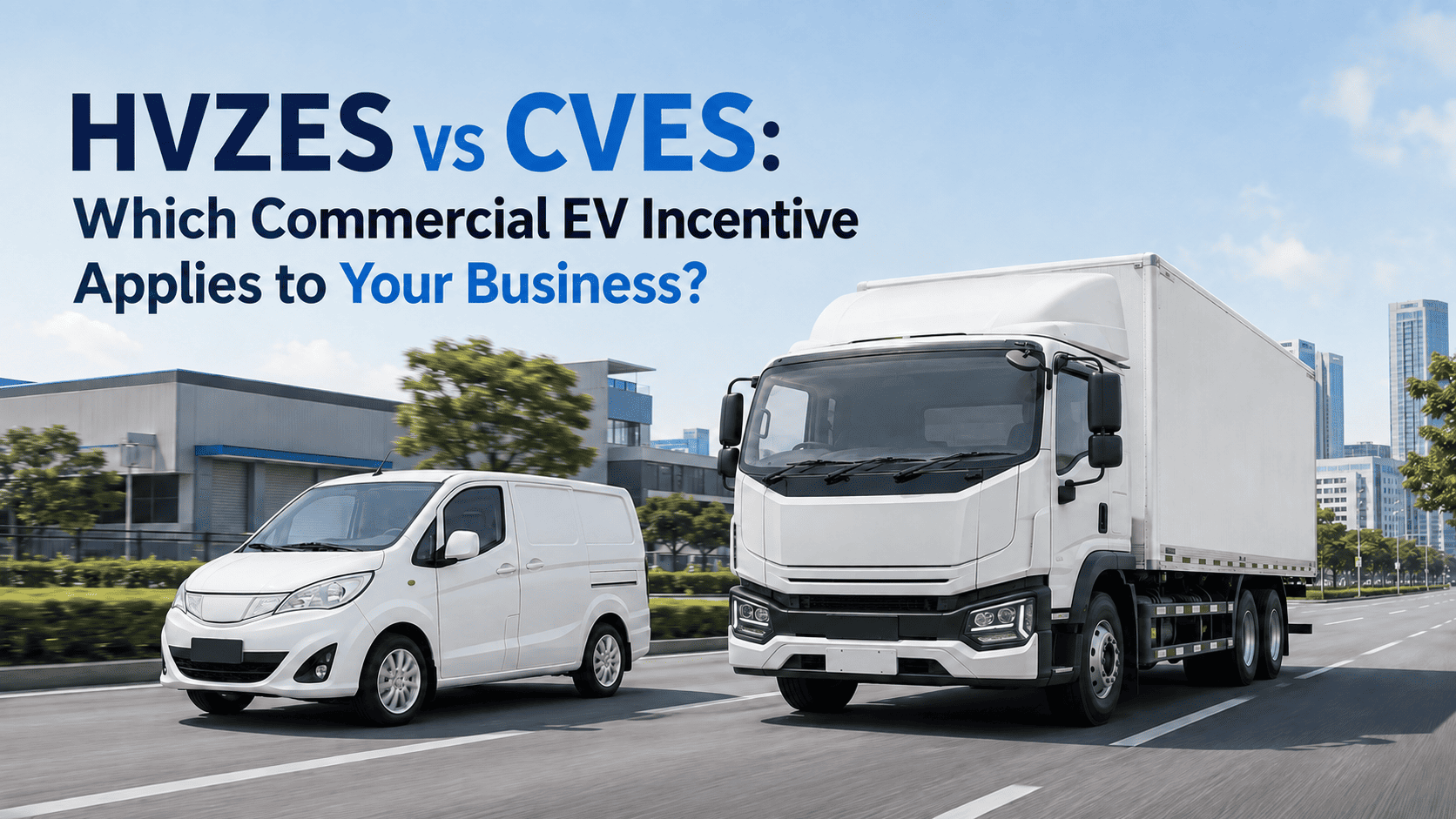
HVZES vs CVES: Which Commercial EV Incentive Applies to Your Business?
Understand the differences between Singapore's HVZES and CVES, including vehicle weight limits, incentive amounts, eligibility periods and their application to commercial EVs.
Businesses purchasing a commercial electric vehicle in Singapore may qualify for an emissions-related incentive under either the Commercial Vehicle Emissions Scheme (CVES) or the Heavy Vehicle Zero Emissions Scheme (HVZES).
The applicable scheme is not determined simply by whether a vehicle is described as a van or a truck.
One of the key starting points is the vehicle's Maximum Laden Weight (MLW):
MLW of not more than 3,500 kg
Commercial vehicles with an MLW of not more than 3,500 kg may fall under CVES.
MLW exceeding 3,500 kg
Eligible zero-tailpipe-emission heavy vehicles with an MLW exceeding 3,500 kg may qualify under HVZES.
Both schemes support the adoption of cleaner commercial vehicles, but they apply to different vehicle categories and have their own eligibility conditions, incentive amounts and disbursement arrangements.
This guide explains how CVES and HVZES work and what businesses should confirm when selecting a commercial EV.
What Is Maximum Laden Weight?
Maximum Laden Weight refers to the maximum permitted operating weight of a vehicle when it is fully loaded.
It generally includes:
- The vehicle itself
- The driver and passengers
- Cargo
- Installed equipment
- Additional accessories or body modifications
MLW is not the same as payload.
Payload
The maximum combined weight of the cargo, occupants and additional equipment that the vehicle is permitted to carry.
Maximum Laden Weight
The maximum permitted total weight of the vehicle when fully loaded.
This distinction is important because the MLW threshold of 3,500 kg is one of the key factors used to determine whether a commercial vehicle may be assessed under CVES or HVZES.
HVZES vs CVES at a Glance
| Feature | CVES | HVZES |
|---|---|---|
| Full name | Commercial Vehicle Emissions Scheme | Heavy Vehicle Zero Emissions Scheme |
| Main vehicle category | Light commercial vehicles | Heavy goods vehicles and buses |
| MLW | Not more than 3,500kg | More than 3,500kg |
| Vehicle emissions | Classified into Bands A, B or C | Must have zero tailpipe emissions |
| EV incentive | S$15,000 for eligible Band A vehicles | S$40,000 for eligible vehicles |
| Current eligibility period | 1 April 2025–31 March 2027 | 1 January 2026–31 December 2028 |
| Payment structure | Full Band A incentive upon registration | Paid in three tranches over three years |
| Main purpose | Encourage cleaner light commercial vehicles | Support the adoption of zero-emission heavy vehicles |
This table provides a general comparison. Final eligibility depends on the official vehicle classification, registration details and prevailing scheme conditions.
What Is the Commercial Vehicle Emissions Scheme?
The Commercial Vehicle Emissions Scheme (CVES) was introduced to encourage the adoption of cleaner light commercial vehicles in Singapore.
It applies to qualifying new and used imported light commercial vehicles, including:
- Light Goods Vehicles
- Goods-Cum-Passenger Vehicles
- Small buses
To fall under CVES, a vehicle must have an MLW of not more than 3,500 kg.
Under the scheme, vehicles are classified according to their emissions performance. The assessment is based on the vehicle's worst-performing pollutant among the following:
- Carbon dioxide
- Hydrocarbons
- Carbon monoxide
- Nitrogen oxides
- Particulate matter
The vehicle is then placed in Band A, B or C.
For vehicles registered between 1 April 2025 and 31 March 2027:
| CVES band | General description | Incentive or surcharge |
|---|---|---|
| Band A | Electric and least-pollutive vehicles | S$15,000 incentive |
| Band B | Mainly petrol vehicles | No incentive or surcharge |
| Band C | Mainly diesel and more-pollutive vehicles | S$20,000 surcharge |
The table reflects the official emissions bands and does not indicate that one individual vehicle model is inherently better or worse than another. The applicable band is determined by the vehicle's official emissions assessment.
The full S$15,000 Band A incentive is disbursed to the vehicle owner upon registration of an eligible vehicle. These figures apply to the current CVES period ending on 31 March 2027.
Refer to the official LTA and NEA CVES announcement for the latest information.
Which Vehicles May Qualify for HVZES?
Based on the current official requirements, a vehicle must generally meet the following conditions:
- Be classified as a heavy goods vehicle, goods-cum-passenger vehicle or bus
- Have an MLW exceeding 3,500 kg
- Produce zero tailpipe emissions
- Be registered between 1 January 2026 and 31 December 2028
- Have ARF payable at the point of registration
- Fulfil the prevailing registration, ownership and incentive conditions
Businesses should confirm eligibility and understand the disbursement schedule before factoring the full S$40,000 incentive into their purchase budget.
The second and third HVZES tranches also depend on the vehicle remaining registered and the recipient being the registered owner on the relevant registration anniversary.
How Vehicle Category and MLW Affect Scheme Applicability
It should not be assumed that every electric van is assessed under CVES or that every electric truck is assessed under HVZES.
The vehicle's marketing name or body style does not determine the applicable scheme by itself.
A truck with an MLW not exceeding 3,500 kg may be assessed as a light commercial vehicle under CVES.
A vehicle with an MLW exceeding 3,500 kg may be considered under HVZES if it falls within an eligible heavy-vehicle category and meets the remaining requirements.
The appropriate starting question is therefore:
What is the vehicle's official Maximum Laden Weight?
This should be confirmed for the exact vehicle variant and body configuration being registered.
| Payment stage | Incentive amount |
|---|---|
| Upon vehicle registration | S$13,000 |
| First registration anniversary | S$13,000 |
| Second registration anniversary | S$14,000 |
| Total | S$40,000 |
The first S$13,000 tranche is used to offset the vehicle taxes and fees payable upon registration, excluding the administrative fee for registration at an LTA counter. Any remaining amount is paid to the registered vehicle owner.
The second and third tranches are paid to the person registered as the vehicle owner on the respective registration anniversaries. The vehicle must remain registered on those dates for the corresponding payments to be disbursed.
If the vehicle is deregistered before its first registration anniversary, the second tranche will not be disbursed. If it is deregistered before its second registration anniversary, the third tranche will not be disbursed.
These conditions form part of the scheme's disbursement structure and should be considered when planning the vehicle's ownership period.
Full conditions are available in the official LTA HVZES Terms and Conditions.
A Simple Way to Identify the Applicable Scheme
Businesses can use the following steps as an initial guide.
Confirm the Vehicle Category
Check whether the vehicle is officially registered as a:
- Light Goods Vehicle
- Heavy Goods Vehicle
- Goods-Cum-Passenger Vehicle
- Bus
- Other commercial vehicle category
Check the Maximum Laden Weight
- MLW of not more than 3,500 kg: Check whether CVES applies.
- MLW exceeding 3,500 kg: Check whether HVZES applies.
MLW is an initial guide. The remaining vehicle, emissions and registration requirements must also be confirmed.
Confirm the Emissions Classification
For CVES, confirm whether the vehicle is officially classified under Band A, B or C.
For HVZES, confirm whether the vehicle meets the zero-tailpipe-emission requirement.
Check the Registration Date
The vehicle must be registered within the applicable scheme period:
CVES
1 April 2025–31 March 2027
HVZES
1 January 2026–31 December 2028
Confirm How the Incentive Is Disbursed
CVES and HVZES have different disbursement arrangements.
The CVES Band A incentive is disbursed in full upon registration. The HVZES incentive is disbursed in three tranches over three years to the person registered as the vehicle owner at the relevant time.
They are separate but complementary schemes, each with its own eligibility conditions. Refer to the official LTA announcement for details.
Frequently Asked Questions
Is CVES the same as VES?
No. CVES applies to qualifying light commercial vehicles, while VES primarily applies to cars and taxis. Businesses purchasing commercial vehicles should confirm whether CVES or HVZES is relevant to the selected vehicle.
Can an electric truck qualify for CVES?
Potentially. An electric truck may fall under CVES if its official vehicle category is eligible, its MLW does not exceed 3,500 kg and it meets the remaining CVES conditions.
The description "truck" alone does not determine the applicable scheme.
Can an electric van qualify for HVZES?
Potentially. An electric van may be assessed under HVZES if it falls within an eligible heavy-vehicle category, has an MLW exceeding 3,500 kg and meets the remaining requirements.
Eligibility depends on the vehicle's official classification rather than its marketing description alone.
Is the full HVZES incentive paid when the vehicle is registered?
No. The incentive is disbursed in three tranches:
- S$13,000 upon registration
- S$13,000 on the first registration anniversary
- S$14,000 on the second registration anniversary
The applicable disbursement conditions must also be met.
How much is the current CVES incentive for a commercial EV?
An eligible Band A vehicle registered within the current CVES period may receive an S$15,000 incentive, subject to the prevailing conditions.
Can eligibility be determined from the vehicle's payload?
Payload alone does not determine which scheme applies. Payload and MLW are different measurements, and the relevant weight threshold is based on Maximum Laden Weight.
Does every zero-emission heavy vehicle automatically qualify for HVZES?
HVZES eligibility is determined using several conditions. In addition to meeting the zero-tailpipe-emission requirement, the vehicle must meet the applicable vehicle-category, MLW, registration-period, ARF and ownership conditions.
Accord Solutions provides electric vans and trucks for different commercial applications in Singapore. Our team can help businesses compare vehicle specifications, review the relevant vehicle category and explore suitable financing and charging solutions.
Information is based on the prevailing official scheme details available as of July 2026. Incentives, eligibility requirements and registration conditions may be revised by the relevant authorities. Final eligibility is subject to LTA and NEA assessment.